
O JERUSALEM! Crossroads of Three Faiths – Notes on the Program
The Four Quarters of Old Jerusalem: A Musical Tour
by Jeannette Sorrell
I. The Backdrop
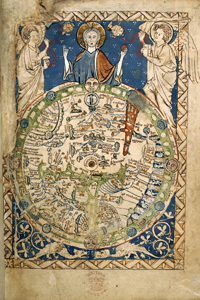
To understand the music and poetry of Jerusalem, we need to understand something of its history and how it has resonated in the world. Ever since the Romans sacked Jerusalem and destroyed the Temple in 70 A.D, taking the Jews to Rome as slaves and scattering them across Europe… the West has inflicted its violent legacy on this city. During the Crusades of the Middle Ages, the Biblical idea of a heavenly Jerusalem began to take hold in Western imagination as a dream. Christopher Columbus was driven by the idea of reclaiming Jerusalem. In the 19th and early 20th centuries, the British Empire brought colonial domination to Palestine –stirring up local tensions and planting the seeds of Jewish-Arab conflict.
With this legacy as a backdrop, our program looks not at the politics, but at the people themselves. Throughout history, Jewish, Muslim, and Christian neighbors in Jerusalem have lived together, celebrating love and life, weddings and prayer. This was perhaps especially true during the roughly 500 years from which most of our music is drawn, 1250-1750.
The interweaving of the spiritual and the secular in the fabric of daily Jewish and Muslim life makes it impossible to separate “secular” folk music from the “sacred” songs of the synagogue and mosque. They are simply different expressions of the same spiritual longing and love. And so, as we evoke the sounds of Old Jerusalem, we interweave the rhythms of daily life – including love and betrayal; feasting and celebration; and the sacred hymns of the temple, mosque, and church.
II. Tour of the City
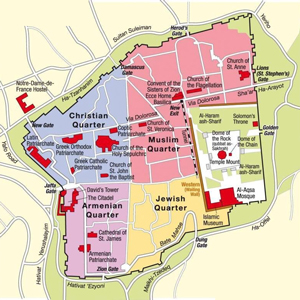
Our musical “tour” of the city has a 5-day itinerary.
Day 1: O Jerusalem!
As we approach the City on a Hill, we hear the theme that resounds so soulfully for scattered Jews and Palestinians: the longing for Jerusalem. We begin with an ancient Jewish Sephardic chant handed down through oral tradition – Ir me kero, madre, a Yerushalayim (“I want to go to Jerusalem, Mother”). My arrangement of this chant is a kind of kaleidoscopic soundscape intended to evoke the Middle East. The treatment of the chant melody reflects different ways in which the Sephardim approached their synagogue singing: first the chant melody is sung by a solo cantor, then as a call-and-response between the cantor and chorus.
This is followed by the lively Sephardic folk song Kuando el Rey Nimrod — a ballad about the birth of Abraham. The Sephardim were the Jews who had been brought to Spain, where they flourished for several centuries and developed a high culture in Medieval times – only to be expelled by the king in 1492. Kuando el Rey Nimrod is the anthem of the Sephardic community; there are even legends of it being sung by the Sephardim as they marched out of Spain in 1492 (though this cannot be true since the music was written centuries later). The song is merry on the surface, but tinged with defiance.
Day 2: The Jewish Quarter
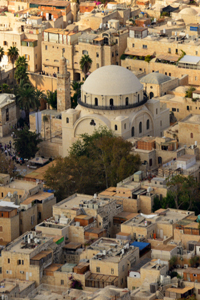
Two contrasting Ladino folk songs highlight the lives and passions of women. Ija Mia (My Daughter) represents the Sephardic tradition of women’s singing and storytelling. From the Ottoman region, this song presents a playful dialogue between a mother eager to marry off her daughter and a defiant young woman who rejects one eligible suitor after another, as her heart is set on a candidate her mother would not approve of. Evoking themes of love and betrayal, Nani Nani is a devastating lullaby-ballad sung by a mother who lulls her baby to sleep while she knows that her husband is with another woman.
We then turn to religious life. The traditional Hebrew hymn Tzur Mishelo is a table-grace sung at meals. El Eliyahu is a Havdalah piyut (Jewish liturgical poem) widely sung among Sephardi and Middle Eastern Jewish communities. The prophet Elijah (Eliyahu), a symbol of redemption in Jewish liturgy, is invoked on Saturday night in a ceremony that bids farewell to the peace of Shabbat and expresses longing that the week ahead may be filled with blessings. The melody we perform with this piyut comes from the Babylonian/Iraqi tradition.
Day 3: The Christian & Armenian Quarters
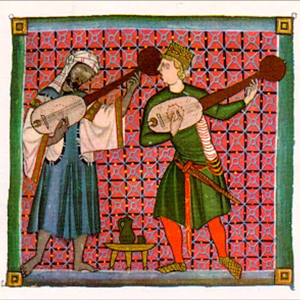
Just before intermission, we get swept up in a joyous procession – the medieval cantiga, Santa Maria, Strela do Día (Saint Mary, Star of the Day). Our performance is inspired by the vibrant street festivals of the Feast of the Assumption, still seen in Spanish and Italian communities today. The melody and lyrics are found in the 13th-century manuscript known as the Cantigas de Santa Maria Codex, a beautifully illuminated manuscript written in the Galician Portuguese language. The manuscript contains many colorful illustrations of musicians – including images of Christian (white) and Muslim (brown) musicians playing together. As with all medieval manuscripts, only the melody was provided, and there is no indication of which instruments should play, if any. I lightly arranged the song for our ensemble of strings, voices, and plucked instruments.
Day 4: The Muslim Quarter
Our Palestinian oud player, Ronnie Malley, leads us to the Muslim Quarter with a brilliant oud taxim (improvisation). There we encounter a joyous dance scene, as the Longa Farafahza erupts with virtuosity. The Longa dance (Arabic: اجنول) originated in Turkey, into Arabic music. It is a popular Ottoman-era classical instrumental form with melodies that evoke lively upbeat Eastern European dance music.
This is followed by two Palestinian folk songs. The soulful lament Hadi Ya Bahar Hadi (Keep Calm, O Sea), speaks of returning home after a long journey. Palestinians in exile sing this song as a lament to return to the land.
The folk song Ala Dal’ouna is a traditional dabke folk dance-song. Dabke is the Arabic word meaning “to stomp the ground”, which evolved into a communal dance representing villagers who would stomp the mud-and-straw roofs of homes to compact them. The song pays homage to Palestinians’ connection to the land, its agricultural riches, and sowing the earth with the help of nearby neighbors.
Day 5: Mosque, Synagogue, and Cathedral
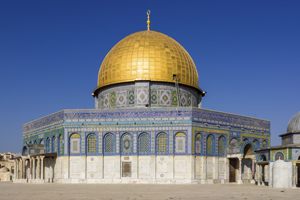
at the center of the Al-Aqsa mosque
The Greek Orthodox community of Jerusalem is represented by Agni Parthene (“O Virgin Pure”), a beloved hymn composed by St. Nectarious of Aegina in the 19th century. A medley of three short Abrahamic chants arranged by Ronnie Malley brings together the Hebrew, Syriac, and Arabic languages. The three texts come from the 16th-c. Jewish rabbi Elizar Azikri; the 4th-c. Christian theologian St. Ephraim of Syria; and the 13th-c. Sheikh Abdulrahman Al-Buri’i.
Jeffrey Strauss’ Jewish cantorial improvisation, Ki Eshmera Shabbat, begins with the Sephardic melody Ir me kero made Yerushalayim which opened our program – and takes it to dramatic heights. Excerpts from the great Monteverdi Vespers of 1610 reveal how Monteverdi’s writing was influenced by the sounds of the Jewish and Arab sacred chanting. In all of this music, florid ornamentation in mostly minor modes soars above slowly changing harmonies that move with inevitability.
Day 6: Neighborhood Celebration
Our tour of Jerusalem draws to a close by evoking an era when Jews, Egyptians, Palestinians, and Christians all lived together in Jerusalem, sharing songs, stories, and breakfast. Music and feasting take over the streets as neighbors come together to celebrate – joining in the raucous Sephardic Ladino folk song, La Komida la Manyana (The Morning Meal), written in lively 7/8 rhythm.
It is with love and respect that we offer these performances of the music of the peoples of Jerusalem.
This program has been a labor of love for many of us at Apollo’s Fire. As we strive to bring respectful authenticity to the cultures represented here, I would especially like to thank four of my colleagues who have been my closest collaborators. Daphna Mor and Ronnie Malley, as expert Middle Eastern musicians, have brought several beautiful contributions to the program; Jeffrey Strauss’ background in Jewish cantorial singing has helped to shape several pieces; and René Schiffer, my fellow half-Jewish/Hungarian comrade, composed the vibrant bass lines that animate several pieces on the program. It’s a joy as a director to collaborate with such a committed cast as we honor the people of the Middle East with Passion. PERIOD.
©2026 Jeannette Sorrell | Cleveland, OH