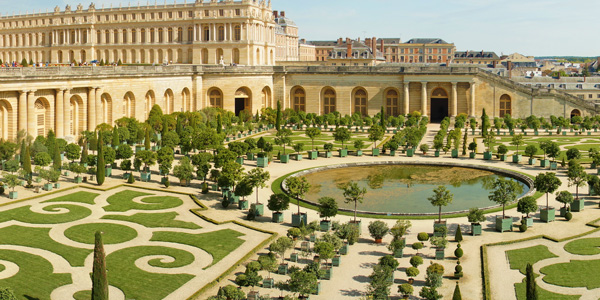
The Palace and Grounds of VersaillesWe are excited to welcome all of you to the heart of 17th and 18th-century France, celebrating the grandeur, elegance, and theatricality of the music created for the Palace of Versailles. Under the reign of Louis XIV, the Palace was not just a residence but the center of French artistic life, where music served as an essential backdrop to court ritual, entertainment, and propaganda. The works performed tonight are a musical reflection of the Sun King’s vision: from the ceremonial processionals that defined his daily life, to the sumptuous ballets and operas that captivated the nobility, and the refined chamber music played in the private apartments.
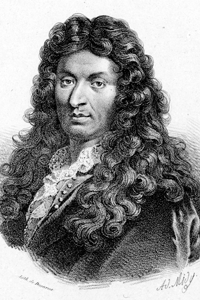
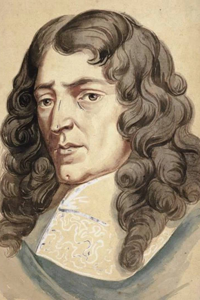
Jean-Baptiste Lully, c. 1670Jean-Baptiste Lully (1632–1687) was an Italian-born composer, dancer, and instrumentalist who became the single most important and influential musician in the court of Louis XIV. Born Giovanni Battista Lulli in Florence, he moved to France as a teenager, where his talents as a violinist and dancer caught the attention of Louis XIV, who later appointed him the title of “Superintendent of Music” in the royal court. In this position, Lully effectively held a monopoly over musical and operatic productions in France. In addition, his close friendship with the playwright Molière led to many collaborations and the birth of the comédie-ballet, an interwoven genre consisting of three elements – spoken comedy, sung music, and elaborate ballet.
Premiered in 1670, Le Bourgeois Gentilhomme (“The Bourgeois Gentleman”) is the most famous of Lully’s comédie-ballet, commissioned by Louis XIV himself. Our opening set today consists of two selections from this work – the Marche pour la cérémonie des Turcs (“March for the Turkish Ceremony”) and the Canarie. Characterized by its grand, processional rhythm, the Marche is an iconic example of the turquerie – the 17th-century European fascination with all things Ottoman. The Canarie is a light-hearted, lively dance thought to have originated in the Canary Islands, characterized by dotted rhythms in compound time, often with complex footwork and leaps in the dancing.
Sandwiched between these two movements from the comic genre is a selection from a tragedie en musique by Lully – the Passacaille from Armide. The tragedie en musique (literally “tragedy in music”) is the French equivalent of the Italian opera and was created by Lully to suit the tastes and language of the French nobility, emphasizing poetic declamation and spectacle over the pure vocal virtuosity found in Italian opera. A passacaille is a stately dance built over a repeating bass line, and appears in the second act of Armide. It accompanies the powerful moment where the sorceress Armide, having captured the crusader Renaud and about to kill him, suddenly falls in love with him while he is asleep. The Passacaille serves as a musical/dance interlude that accompanies the performance of supernatural spirits who ensure Renaud remains deeply asleep, whilst Armide debates her tumultuous and conflicting feelings.
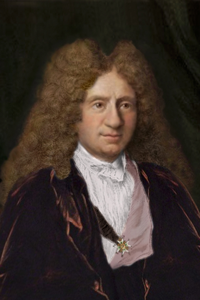
Portrait of de LalandeWhile Lully’s authority and monopoly in the Palace was formidable, they existed mostly in the realm of the secular stage and chamber music. In 1683, there existed an urgent need to fill four vacant positions in the Royal Chapel, to be held by composers who would be responsible for all the sacred music required for the King’s daily masses and religious ceremonies. To do this, the King organized a big contest to find the most talented composers in France. Three composers – Pascal Collasse, Guillaume Minoret and Nicolas Goupillet – were appointed with the backing of influential court figures, including Lully. The fourth choice was appointed directly by Louis XIV himself: Michel-Richard de Lalande (1657–1726).
“Gentlemen, I have duly accepted those you have presented to me. It is only right that I choose one to my taste and I appoint Lalande…” – Louis XIV, 1683.
With the King’s backing, de Lalande rose through the ranks swiftly, gaining sole control of all sacred music at the court by 1704, and writing monumental grand motets (large-scale sacred works). He also started to compose secular music, particularly after the death of Lully in 1687. His most significant secular collection is his Simphonies pour les Soupers du Roy (“symphonies for the King’s suppers”), which consists of numerous dance suites intended to provide an elegant and noble background for the highly ritualized ceremony of the King’s public and solemn evening meals.
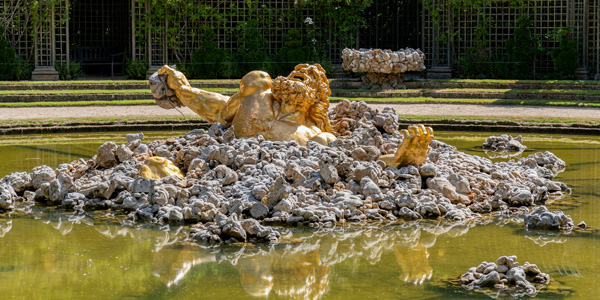
Enceladus fountain in the Gardens of Chateau de VersaillesLa Fontaines des Versailles (“The Fountains of Versailles”) is taken from this collection of Simphonies. Written to celebrate the architectural wonder that was the fountains and waterworks in the gardens of the Palace of Versailles, this suite evokes magnificence right from its opening Overture. The Air de Ancelade depicts one of the most dramatic fountains in the Palace – that of the titan Ancelade half-buried beneath a pile of rocks, struggling against his punishment for attempting to overthrow the Olympian gods (like Jupiter and Apollo). The powerful jet of water that springs from Ancelade’s mouth represents his final, struggling cry, and with this fountain Louis XIV put out a warning to any rebellious nobility that might dare to challenge the Sun King’s authority. The dramatic Air is followed by the vocal number Plaintes, regrets (Laments, regrets), performed today with plaintive oboes taking the role of the singers. Although melancholic in feeling, the text of the movement speaks of the desire for harmony and utopia within the Palace:
Regrets, complains, unnecessary alarms do not increase our pleasures. We don’t want tears here, we are only looking for pleasures.
A triumphant and lively Chaconne closes our selection of movements from this rousing work by de Lalande.
Engraving of Jean-Marie Leclair by F. Lugi d’après Loir, 1741Often called the “father of the French violin school,” the music of Jean-Marie Leclair (1697–1764) masterfully blends the refined elegance and dance rhythms of the French Baroque with the demanding virtuosity and fireworks of the Italian concerto tradition. His Violin Concerto in A minor, Op. 7 No. 5, plunges us right into the storm from its tumultuous opening ritornello, where the influence of Antonio Vivaldi is ever present. We get respite in the lyrical and expressive second movement, which is a pastoral Siciliano in F major. A brief, contemplative Adagio with tense harmonic suspensions functions as a brief, contemplative bridge before the high-spirited Allegro assai. This finale begins with a similar drama as the opening movement and continues like this for a while, before we are presented with a surprising A major section that exudes rustic charm and cheer. Here, we hear Leclair as a composer who was transitioning into the Classical era with elements of the galant style. The brief return of the A minor to conclude the movement is almost too quick to take us out of the sunny peace we experienced in the A major.
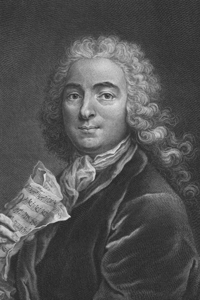
Portrait of Marc-Antoine Charpentier, c. 1754Perhaps no French Baroque program is quite complete without Lully’s rival: Marc-Antoine Charpentier (1643–1704). As a young man, Charpentier went to Rome to study with Giacomo Carissimi, and brought back with him elements of the Italian style that were unique, such as his complex use of harmony and counterpoint. Lully viewed Charpentier as a threat and used all the powers granted to him by the King to block Charpentier’s career. When Molière fell out with Lully in 1672 and turned to work with Charpentier, an enraged Lully passed a rule stating that no theater troupe (other than his own) could use more than six singers and twelve instrumentalists, and pushed it even further in 1673 to restrict rival shows to just two singers and six violins. This, together with the fact that no one in France could perform an opera without Lully’s written permission, forced Charpentier into the shadows for much of his career, until Lully’s death in 1687.
Yet, Charpentier shows us that even intimate chamber works can possess immense expressive power in his Concert pour 4 parties de violes, H. 545, consisting of six movements. It is widely believed that Charpentier wrote this for the Duchess of Guise, a big patron of the arts who maintained her own private “mini-court” that rivaled Versailles in quality, if not in size. Because she stayed away from Lully’s sphere of influence, Charpentier had the freedom to work for her and enjoyed her patronage for almost 20 years. The work’s original scoring for viol consort hearkens back to the Renaissance, but with Charpentier’s Italian influences shining through. The independence of the four voices right from the opening Prelude is remarkable and unusual in its time and place, as they seem to “talk” to each other, finishing each other’s sentences and weaving in and out. The closing Passecaille features a cross-relation between the upper two voices, whereby the top part’s C-sharp is heard simultaneously with the second part’s C-natural – clashing instantaneously, yet fleetingly. Tonight, the piece will be performed with instruments from the violin family, which were the dominant instrumental family over the viols by this point in history.
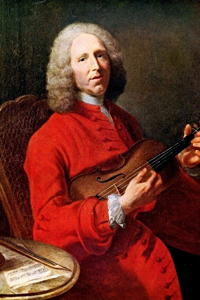
Jean-Philippe Rameau attributed to Joseph AvedStepping forward in history, we arrive at the music of another French giant: Jean-Philippe Rameau (1683–1764), best remembered today for his many operas. Yet, unlike Lully who composed (in fact, invented) French opera throughout his career, Rameau only wrote his first opera at the age of 50. Les Indes Galantes is perhaps Rameau’s most famous works, commonly thought of as an opera-ballet with its notably large number of instrumental dances interspersing with the vocal numbers. The opera reflects the French court’s fascination with global cultures at this time in history, consisting of four acts set in locations such as Turkey, Peru, Persia and the Americas.
Today’s selection of ten instrumental numbers span all four acts of Les Indes Galantes, including the famous Les Sauvages which Rameau recycled from a harpsichord piece in 1725. The piece was inspired after Rameau saw two Louisiana Native American chiefs perform a dance in Paris. He was so enraptured by it that he sought to capture it in music. The title (whilst sounding condescending in today’s context) refers to the “Noble Savage” archetype in 18th-century Enlightenment, used to represent people that are “naturally good” and who live in harmony with nature, untainted by modern civilization. Hence, in the opera, the Native American princess Zima rejects jealous advances by her European suitors to be with the indigenous leader Adario, symbolizing the pure, honest love that exists between them.
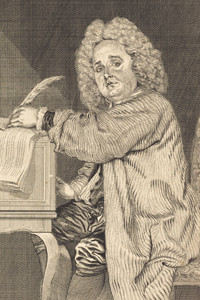
Engraving of Jean-Féry Rebel by Jean-Antoine WatteauIn 1715, the same year Louis XIV passed away, Lully’s student Jean-Féry Rebel (1666–1747) composed a work that would become a sensation across Europe. Les Caractères de la danse is not a typical dance suite; it is a breathless, kaleidoscopic “fantaisie” that condenses an entire evening of ballet into a single continuous movement. Cycling through 11 different court dances, including the Courante, Bourrée, Chaconne, and Sarabande, it is a medley of the most popular dance rhythms that governed social life and ceremony at the Palace of Versailles. The work concludes with a “Sonate” – not strictly a dance but in fact an Italian instrumental genre. Rebel brings out the “Italian-ness” in spades with virtuosic cascades of fast notes throughout the entire orchestra, making for an exciting finale. Is Italy ultimately having the last word in today’s French program? Not as ironic as it perhaps sounds, considering that the entire legacy of French Baroque music was built and transmitted by a man who changed his name from Lulli to Lully.