
FENCING MATCH Round Two – Notes on the Program
‘Fencing’ with Bach, Vivaldi, and Friends
by Jeannette Sorrell
I. “En garde!”
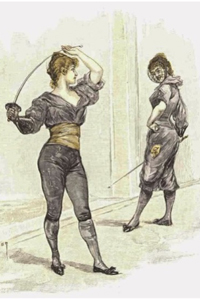 In the 18th century, the art of fencing began to transition from a self-defense skill to a more refined, genteel recreation. Thrusting techniques, as taught in the aristocratic fencing schools of France, emphasized grace, posture, and elegance. In fact, young women began to practice this skill as well as men.
The etiquette of the fencing schools fostered a culture of courtesy and friendship. Swearing, drinking, smoking, and mocking other students was strictly prohibited. Gloves were required. Before engaging in a drill with another student, or before an assault, the students performed a reverence/salute to each other and anyone who may have been watching. This obligatory salute was intended to show respect to the adversary.
It is striking (no pun intended) how much this stylized etiquette resembles the musical genre of 18th-century double-concertos. As developed by J.S. Bach, Telemann, and Vivaldi, these concertos showcase two soloists engaged in dramatic and rhetorical dialogues (often in the first movement of a concerto), gentle conversations (in slow movements), and fiery, spirited arguments (fast movements). The spirit of friendly competition reigns as the two soloists challenge each other to fierce feats of virtuosity in one moment, and then in the next, offer a graceful hand in courtesy. One can easily imagine a soloist shouting “en garde!” before launching into the third movement.
II. Two Friends and an Admired Colleague
Bach and Telemann were close friends, despite the inevitable competition between them. They also shared an admiration for their renowned colleague to the south, Antonio Vivaldi. Our program brings these three mutual admirers together in an evening that highlights their thrilling contributions to the double-concerto genre.
Bach and Telemann seem to have met when both were in their 20’s. In 1714, Telemann became godfather to Bach’s son Carl Phillip Emmanuel. Bach paid tribute to Telemann by transcribing and performing his music. Though Telemann was four years the elder, he was definitely the more trendy and forward-looking of the two composers. His sense of musical humor, lightness, and use of folk elements greatly endeared him to the public. In fact, Telemann received four times as much space in 18th-century German music encyclopedias as Bach did.
The composer whose music Bach most often studied and transcribed was Antonio Vivaldi. There is no surviving record of any meeting between Bach and Vivaldi, but Bach’s admiration for Vivaldi must have been very great. He arranged at least seven of Vivaldi’s violin concertos into keyboard pieces.
Vivaldi was considerably more famous than Bach during the first half of his career. As music master at the prestigious Ospedale della Pietà in Venice (a special school for orphaned girls and illegitimate daughters of the nobility, with an extraordinary emphasis on music), Vivaldi attained great honor throughout Europe. Tourists from as far as England flocked to Venice to attend the concerts of the “redhead priest” and his girls. By 1725, Vivaldi was celebrated throughout Europe.
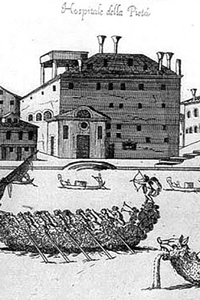 Vivaldi served as music-master to the top-level orchestra of the orphanage – the showcase ensemble. In this role, he composed about 500 concertos for his young female protégés. In writing these concertos for the Pietà orchestra, Vivaldi was the great developer of ritornello form – the form that became the model for concerto-writing by all European composers of the century, including Bach. The Italian word “ritornello” means something that returns. The same word is used to mean the refrain in pop music – and indeed, Vivaldi’s ritornellos convey the bold and driving sense of rhythm that is more commonly associated with pop music. Like pop composers today, Vivaldi was writing for teenagers.
III. The Music
The Allegro from Vivaldi’s Concerto Grosso in in D Major sets the stage for our musical fencing evening, as Vivaldi provides fiery solo/duo writing interwoven with a spirited ritornello.
We then move to Telemann’s Concerto in E Minor for Flute & Recorder. The opening Largo is, in my view, a free and expressive prelude, where the two soloists get acquainted in a gentle conversation. This bursts into a fiery, fugal Allegro, with virtuoso episodes for the two soloists alternating with bold orchestral statements. The folk-inspired Presto (finale) reflects Telemann’s 3-year stint at the court of a Polish count, where summers were spent in the Polish countryside. There, Telemann became acquainted with the folk music of Polish peasants and developed a love for its “barbaric beauty.” The drone bass in this rustic movement suggests outdoor musettes or bagpipes, bringing this concerto to a raucous conclusion.
As with most of Bach’s concertos, the ever-popular Concerto for Two Violins had most likely been written for Cöthen, but Bach revived it for the Leipzig Collegium. The dramatic dialogue of the first movement and the red-hot finale show the influence of Vivaldi in their fiery ritornellos. The serene Adagio in F major is a gentle conversation between the two soloists, like two old friends.
Vivaldi’s Concerto in A Minor for Two Violins is a dramatic and eloquent conversation between two soloists – almost operatic in its emotional range. The second movement evokes a mystical ambiance: a repeated ground-bass pattern begins with all strings in unison, then moves into the upper strings as a repeating mantra while the two soloists weave a celestial conversation around it.
Marin Marais studied composition with Lully and often conducted his teacher’s operas, while also achieving a reputation as a virtuoso viol player. Alcione premiered in 1706 at the Théâtre du Palais-Royal in Paris, and is well known today particularly for its inventive orchestral writing. The graceful Chaconne harks back to the Lully’s influence, and ends the entire opera on an optimistic note. The Act IV tempest scene is widely regarded as one of the earliest portrayals of a storm in opera, and takes place as Alcione dreams of the evil fate awaiting her beloved Ceyx. The Marche des Matelots (Sailor’s March) from Act III draws its tune from an ancient French carol, known today most widely as “Masters in This Hall.”
We close the program with my arrangement of Vivaldi’s trio sonata, La Folia (“Madness”). The traditional folia tune and dance served as inspiration for Vivaldi as well as several other baroque composers (Corelli, Marias, Geminiani, and C.P.E. Bach.) Scholars believe that the dance originated in Portugal, where young girls would engage in the “folly” or “madness” of a wild dance around the fire. The folia is a triple-meter ground bass, beginning in a haughty sarabande-like rhythm and traditionally growing faster and faster toward the end. The tune is full of the dramatic tension of courtship and seduction. Vivaldi’s version of La Folia, which I believe is the finest of them all, was originally a trio sonata; I arranged it as a concerto grosso so that all of us could join in the fray.
© Jeannette Sorrell, Cleveland, 2026
For further reading: The Historical Fencer: Etiquette in the 18th-century Fencing Schools